Geometric Shapes Flashcards for Kids
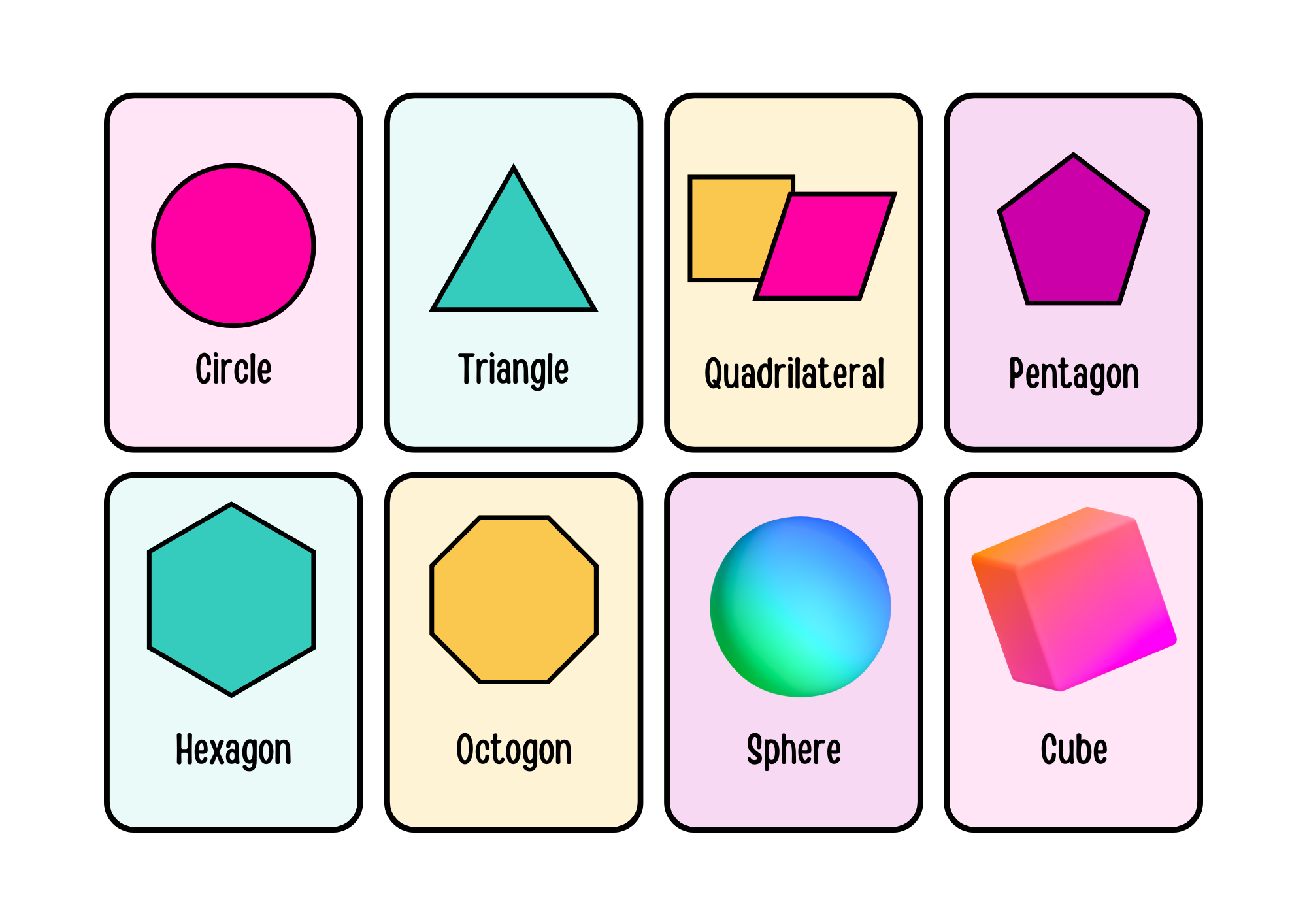
Introducing children to geometric shapes is a fundamental part of early mathematics education. Shapes are everywhere around us, and helping children recognize and understand them opens the door to spatial reasoning, problem-solving, and mathematical thinking. One of the most effective and engaging ways to teach shapes to young learners is through flashcards. In this comprehensive blog, we'll explore how geometric shapes flashcards can transform the learning experience and help children develop a strong foundation in mathematics and spatial awareness.
Why Geometric Shapes Matter in Early Learning
Geometric shapes are the building blocks of mathematics and visual literacy. When children learn to identify and name shapes like circles, squares, triangles, and rectangles, they're developing cognitive skills that extend far beyond basic mathematics. Shape recognition helps children understand patterns, predict outcomes, and analyze their environment more effectively.
Moreover, learning shapes early in life has been linked to better mathematical performance in later grades. Children who develop a strong understanding of shapes show improved spatial reasoning, which is crucial for subjects like geometry, physics, and engineering in the future. Flashcards provide an interactive and visually engaging method to introduce these essential concepts in a fun and memorable way.
The Power of Visual Learning with Geometric Shapes Flashcards
Visual learning is particularly effective for young children, and geometric shapes flashcards are perfect tools for this purpose. Each flashcard features a colorful, clearly drawn shape accompanied by the shape's name in bold, easy-to-read text. The bright colors and simple designs make the flashcards appealing and easy to understand, allowing children to quickly grasp the concept of each shape.
By pairing visual images with their names, children create mental connections between the shape and its representation. For example, when a child sees a bright yellow circle on a flashcard, they begin to associate the word "circle" with that round shape, and soon they start noticing circles everywhere – in wheels, plates, clocks, and the sun. This real-world connection is crucial for deep learning and retention.
Essential Shapes to Include in Flashcard Learning
There are several fundamental geometric shapes that form the foundation of shape learning. Here are the most important shapes to include in your geometric shapes flashcard collection:
- Circle: A round shape with no corners or angles. Children can find circles in everyday objects like balls, plates, and coins.
- Square: A shape with four equal sides and four right angles. It's one of the first shapes children learn and appears in buildings, windows, and tiles.
- Triangle: A shape with three sides and three angles. Triangles are fascinating because they appear in nature, architecture, and even in toys.
- Rectangle: A shape with four sides and four right angles, but unlike a square, opposite sides are longer. Books, doors, and windows are all rectangles.
- Star: A five-pointed shape that's fun and engaging for children. Stars appear in the sky, decorations, and symbols.
- Heart: A shape that represents love and emotion, making it particularly engaging for young learners. Hearts appear in art, decorations, and Valentine's Day themes.
- Pentagon: A shape with five sides. It appears in nature and architecture, introducing children to more complex geometric forms.
- Hexagon: A shape with six sides. Hexagons are found in honeycombs and many natural patterns.
- Oval: Similar to a circle but elongated. Ovals appear in many objects like eggs and mirrors.
- Diamond: A rotated square or rhombus shape. It's visually interesting and appears in jewelry, playing cards, and decorative items.
Creative Activities Using Geometric Shapes Flashcards
Geometric shapes flashcards are incredibly versatile and can be used in numerous creative ways to enhance learning. Here are some engaging activities to make shape learning fun and interactive:
- Shape Matching Game: Lay out flashcards face-down and have children flip them over and match pairs. This develops memory and recognition skills while reinforcing shape identification.
- Shape Hunt: Show a flashcard and ask children to find that shape in the room. This encourages observation and helps children connect abstract shapes to real-world objects.
- Shape Sorting: Create different categories (like shapes with straight sides vs. round shapes) and have children sort flashcards into these groups. This develops critical thinking and classification skills.
- Story Building: Use shape flashcards to create stories. For example, "The square house has a triangle roof, a circle door, and diamond windows." This combines shape learning with creativity and language development.
- Drawing Activity: Show a shape flashcard and ask children to draw their own version. This helps reinforce shape recognition and develops fine motor skills.
- Color Mixing: Use different colored shape flashcards to teach color recognition alongside shape learning. Ask children to identify both the shape and color.
- Counting Shapes: Place multiple flashcards on a table and ask children to count how many triangles, circles, or squares there are. This combines shape recognition with basic mathematics.
Building Confidence and Mathematical Thinking
As children work with geometric shapes flashcards, they develop not just shape recognition skills, but also confidence in their mathematical abilities. Each successful identification builds on their previous knowledge, creating a foundation for more complex mathematical concepts.
Regular practice with flashcards helps children internalize shapes and their properties. They learn that shapes can be rotated, resized, and still remain the same shape. They begin to understand that shapes have consistent characteristics – a circle always has no corners, a triangle always has three sides. This logical thinking is the cornerstone of mathematical reasoning.
Tips for Effective Geometric Shapes Learning
- Use Real Examples: Point out shapes in the child's environment throughout the day. This helps reinforce the connection between flashcard learning and the real world.
- Keep Sessions Short: Children have short attention spans, so keep flashcard sessions to 5-10 minutes. Multiple short sessions are more effective than one long session.
- Make It Fun: Use games, songs, and playful activities to maintain engagement and enthusiasm.
- Be Patient: Every child learns at their own pace. Don't rush the learning process; celebrate small victories.
- Incorporate Multiple Senses: Let children touch and trace shapes, not just look at them. This multi-sensory approach enhances learning and retention.
- Celebrate Progress: Praise children's efforts and accomplishments to build confidence and motivation.
Conclusion
Geometric shapes flashcards are an invaluable tool for teaching young children about the fundamental building blocks of mathematics and spatial understanding. By combining visual learning with interactive activities, flashcards make shape learning engaging, memorable, and fun. Whether you're a parent, teacher, or educator, geometric shapes flashcards offer a proven and effective way to help children develop essential mathematical thinking skills that will serve them well throughout their educational journey. Start with the basic shapes and gradually introduce more complex forms, always keeping the learning experience playful and rewarding. Your child's mathematical foundation starts here, with shapes!