Learning Climate and Weather with Interactive Flashcards
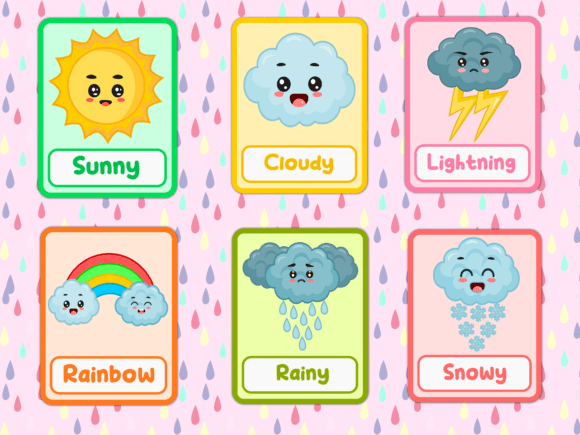
Interactive climate and weather flashcards represent a revolutionary approach to earth science education. By combining sophisticated visual design, engaging interactivity, and adaptive learning algorithms, these digital tools transform abstract meteorological concepts into concrete, memorable learning experiences. Interactive weather flashcards engage children through animations that show weather processes, interactive elements that allow manipulation and exploration, and gamified activities that maintain motivation. This comprehensive guide explores how interactive climate and weather flashcards maximize learning outcomes and provides strategies for optimal implementation.
The Power of Interactive Weather Learning
Traditional static weather flashcards show a picture and a word. Interactive weather flashcards do so much more. They can animate the water cycle, show how weather patterns form, demonstrate seasonal changes through dynamic graphics, and allow children to interact with weather concepts in meaningful ways. This interactivity creates engagement that leads to deeper learning and better retention.
Interactive elements also accommodate different learning preferences. Visual learners benefit from animated processes. Kinesthetic learners benefit from dragging weather symbols or manipulating storm components. Auditory learners benefit from audio descriptions of weather phenomena. A single interactive flashcard can serve multiple learning modalities simultaneously.
Key Features of Effective Interactive Weather Flashcards
The most effective interactive climate and weather flashcards include:
- Animated Processes: Show weather phenomena in motion (rain falling, clouds forming, seasons changing)
- Interactive Manipulation: Allow children to move, rotate, or transform weather elements on the screen
- Multiple Perspectives: Show weather from different viewpoints (satellite view, ground level, close-up)
- Accurate Scientific Content: Represent weather and climate concepts correctly, supporting scientific thinking
- Progressive Complexity: Start with simple weather (rainy, sunny) and progress to complex climate systems
- Comparative Displays: Show contrasts between weather types and climates side-by-side
- Real Data Integration: Use actual weather maps, satellite imagery, and climate data
- Audio Support: Include clear pronunciation and descriptions of weather phenomena
- Gamification: Include points, achievements, and challenges to maintain engagement
- Progress Tracking: Allow students and teachers to monitor learning progress
Animated Water Cycle Learning
One of the most powerful applications of interactive weather flashcards is animated water cycle instruction. The water cycle – evaporation, condensation, precipitation, and collection – is difficult to understand from static images alone. Interactive flashcards can show water evaporating from a lake, rising as water vapor, condensing into clouds, and falling as precipitation, all in smooth, continuous animation.
Children can pause animations to examine specific stages, speed them up or slow them down, and see how the cycle repeats endlessly. This dynamic representation creates intuitive understanding that static images cannot provide.
Climate Zones and Global Patterns
Interactive weather flashcards excel at teaching climate zones and global weather patterns. Rather than simply showing images of tropical, temperate, desert, and polar regions, interactive versions can:
- Show where climate zones are located on interactive maps
- Animate how wind patterns create weather systems
- Display temperature and rainfall patterns for different regions
- Show how ocean currents influence regional climates
- Compare typical weather in different climate zones
- Demonstrate how latitude affects climate
Storm and Severe Weather Education
Interactive flashcards are particularly valuable for teaching about storms and severe weather. Children need to understand these phenomena for safety, but static images may not convey the dynamics of tornadoes, hurricanes, thunderstorms, or blizzards. Interactive representations showing:
- How rotating wind creates tornadoes
- How warm and cold air masses clash to create storms
- How hurricane systems develop and move
- Lightning formation and thunder generation
- Conditions that lead to severe weather
These animated demonstrations help children develop genuine understanding, not just memorization of terms.
Seasonal Transformations and Changes
Interactive weather flashcards can show seasonal transformations in ways that build deep understanding. Rather than showing four separate images of the same landscape in different seasons, interactive versions can:
- Animate seasonal changes across the year
- Show temperature progressions throughout seasons
- Display daylight hours changing through the year
- Show ecosystem changes in response to seasonal weather
- Demonstrate why seasons occur (Earth's axial tilt)
- Compare seasons in different hemispheres
Hands-On Activities with Interactive Flashcards
Interactive weather flashcards support numerous engaging learning activities:
- Prediction Games: Predict what weather will occur based on given atmospheric conditions
- Matching Challenges: Match weather vocabulary to animated demonstrations
- Sequencing Activities: Order steps in weather processes (water cycle, storm formation)
- Data Analysis: Interpret temperature charts, precipitation maps, and weather data
- Climate Comparison: Compare characteristics of different climate zones
- Scenario Exploration: "What if" questions about weather and climate
- Real-Time Integration: Compare local weather to flashcard learning
Connecting Digital Learning to Real-World Observation
The most effective use of interactive weather flashcards combines digital learning with direct observation. After learning about cumulus clouds on interactive flashcards, children can go outside and identify cumulus clouds in the sky. After learning how weather patterns move, they can track actual weather systems using weather apps or maps.
This integration creates multiple reinforcing representations of weather concepts, leading to deeper, more transferable learning. Children develop the ability to not just recognize vocabulary but understand actual weather phenomena they observe.
Building Scientific Thinking and Inquiry
Interactive weather flashcards support development of scientific thinking skills:
- Observation: Carefully observe weather phenomena in animations and real life
- Pattern Recognition: Identify recurring patterns in weather and climate
- Cause-and-Effect: Understand what causes different weather phenomena
- Prediction: Use patterns to predict future weather
- Testing: Compare predictions to actual weather outcomes
- Inference: Draw conclusions about climate based on evidence
Adaptive Learning and Personalization
Advanced interactive weather flashcard platforms use artificial intelligence to personalize learning. The system tracks which weather concepts children understand well and which need more practice, automatically adjusting focus and difficulty. Children who quickly master basic weather conditions progress to complex climate systems, while those needing more support receive additional practice with core concepts.
This personalization ensures optimal challenge levels and prevents both boredom and frustration, maintaining engagement and motivation throughout learning.
Vocabulary Development and Language Skills
Beyond science content, interactive weather flashcards support language development. Children learn weather vocabulary in context, see how these words are used in sentences, and hear correct pronunciation repeatedly. For English language learners, the visual context makes abstract weather concepts concrete and comprehensible, supporting vocabulary acquisition in a second language.
Collaboration and Social Learning
Interactive weather flashcard platforms can support collaborative learning. Children can compete in friendly weather knowledge competitions, work together to solve weather puzzles, and discuss what they're learning. This social dimension adds motivation and supports development of communication skills alongside content mastery.
Building Environmental Consciousness
Interactive weather flashcards can build awareness of climate patterns and environmental systems. As children learn how weather systems work and how climate patterns develop, they begin to understand climate as a dynamic system. Some interactive platforms explicitly address climate change, showing how global patterns are shifting and what impacts are occurring.
This understanding develops into environmental literacy – recognition that weather and climate are interconnected global systems that humans depend on and must be responsible stewards of.
Conclusion
Interactive climate and weather flashcards represent a significant advancement in earth science education. By combining accurate scientific content, engaging animations, interactive elements, and adaptive learning technology, these tools create optimal conditions for developing weather and climate understanding. When combined with real-world observation, hands-on activities, and meaningful discussion, interactive weather flashcards help children develop rich, deep understanding of the atmospheric processes and climate patterns that govern our world. The result is students who understand weather not as abstract vocabulary but as observable phenomena they can predict, explain, and appreciate – and who develop genuine interest in and respect for the dynamic earth systems that sustain life. Interactive weather flashcards make this transformative learning possible!